
Econological perspectives
I'll bet there's already a word for this, but when it comes to the collision of the economics and ecology of things we're doing, I call it "econological." Spell check doesn't like it, so I'll claim it as my own word.
This story starts in summer 2021 while spraying a fallow field. It had been a particularly wet summer, making it difficult to get the sprayer in the fields. Late July and I was finally spraying some chem fallow to prep for wheat that September. By this point, weed growth was far beyond what they would normally be allowed, maybe 3-4’ tall with some flowering. I really needed to mount machetes on the front of the sprayer.
The sprayer can Waymo itself across the field while the boom automatically adjusts its height, leaving me with little to do but stare out the window and daydream. I remember looking out the bottom corner of the front window at the blur of green hues passing by at 12mph, transfixed by vacillating textures, heights, and flowers. Furthermore, as weeds changed, there was a shift in critters. Some areas exploded with hopping things. Other parts filled the air with flying things. And some areas seemed to have no things at all. And an epiphany hit me that has influenced my management ever since: There’s no such thing as a weed problem. If fact, weeds are a solution, albeit not our preferred. The patterns are not random or even coincidental, but glaring neon signs.
This is not remotely a novel idea. Guardians of the Soil, for example, was published in 1950. There is, however, a difference between “knowing” something because you read it somewhere versus the realization crashing down on you. I began to constantly ask myself, why are my fields weedy? Ask any farmer this question and the answer is usually because it hasn’t been sprayed or tilled yet, but that doesn’t answer the question. My conclusion became that what was a diverse, perennial community has been converted to an annual monoculture, and virtually all agronomic problems originate here. In this light, debates of tillage versus herbicides are off the mark as both are rather heavy-handed tangential approaches to holding an unstable system together. So I sincerely wondered, is organic no-till cropping feasible when even the go-to practices such as roller-crimp rye have been shown to be very unreliable in this area. Is there a diverse perennial scenario for our farm?
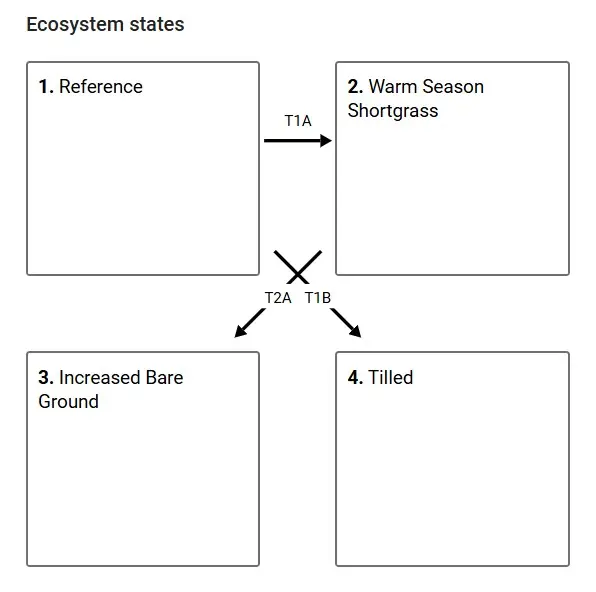
If I may nerd out for a minute - one can examine the state-and-transition models in NRCS Ecological Site Descriptions (ESDs) for some context. The premise being that under a given combination of soil, climate, and management (or disturbance regime), the ecological system will organize itself in predictable, recognizable ways. Shortgrass prairie soils typically farmed can be a mid-grass community, sodbound grama, or highly variable annual dominant with an open nutrient cycle characteristic of highly disturbed sites. Newsflash – both tillage and pesticides are massive unnatural disturbances in their own rights.
Moisture buffers these effects and adds resilience. Use Savory’s brittleness scale or whatever you like, but the moisture regime with regard to total amount, distribution throughout the year, and evapotranspiration losses will affect how much energy (inputs) will be required to hold an unnatural condition together when things don't go as planned. Farming difficulties in eastern Colorado, especially with regard to soil health practices, are often blamed on low precip. However, I think if you sent me 12” precip AND told me exactly how it will come, I can grow decent crops. The variability and unpredictability is a bigger challenge than the total.
On a related note, I also contend that there’s no such thing as “drought”. At least not in the sense that the term gets thrown around. For any ecological attribute, there’s a range of natural variability. Another newsflash – months of little to no moisture are well within the RNV of shortgrass steppe. Our unwillingness to plan around this does not make us “victims” of drought.
Put it all together, and I find I'm making the case to myself that I shouldn’t continue dryland farming in eastern Colorado. In fact, I don’t think anyone would without the various forms of government subsidy. 50+ years ago $4 corn was profitable and worth the risk, but these days it mainly just serves to boost the amount of the ensuing bailout check. If the bulk of my time, energy, and money are "subsidizing" a land use that is fundamentally inappropriate for my region, then what should I be doing instead?
The simple and obvious answer is to sell all farm equipment, plant all cropland back to grass, and change Schreiber Farm & Ranch to just Schreiber Ranch. I’m primarily a range and wildlife ecologist, so I’m not opposed to that idea, however I am inclined to preserve the farming legacy of a 99-year-old operation. So the discussion thus far has shaped what's evolved to be the foremost goal of our operation: transitioning towards perennial and livestock systems, namely Kernza and pasture cropped rye, the details of which I'll delve into shortly.
In the course of exploring the topic, I fairly recently learned that "perennial" isn't just an adjective, but also a verb and a noun. So come to find, "perennialization" is the word for what we're working towards...even if it's not my own word.